
Conversation design for AI-powered support
I led conversation design and evaluation for the launch of SentinelOne's AI support chatbot to improve self-service resolution and drive case deflection.
Company: SentinelOne
Role: Senior Staff Content Designer
Timeline: 2025–2026
Expertise: Conversation design, AI UX, prompt design, LLM evaluation
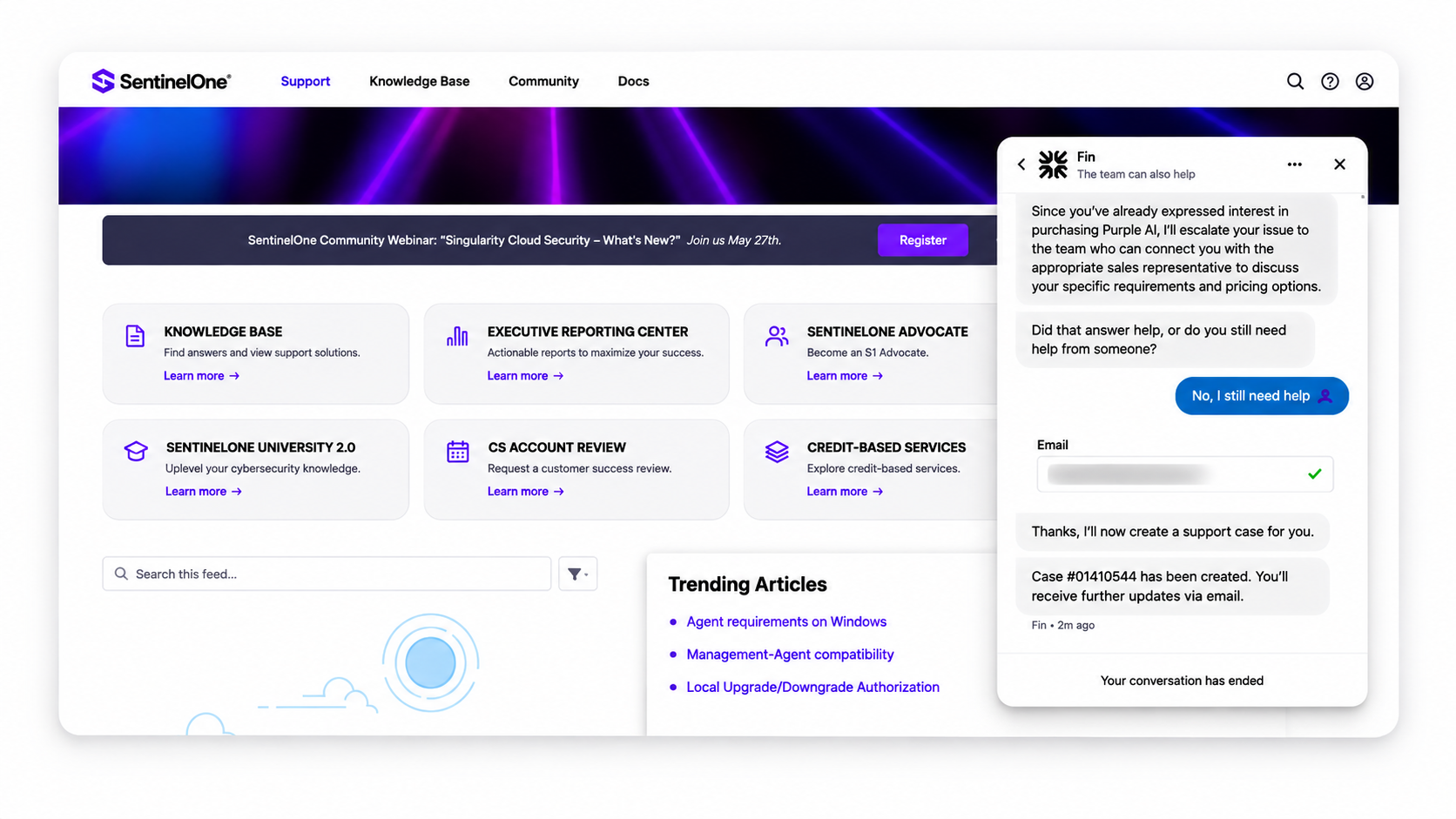
The chatbot escalation experience I designed to help customers transition from self-service to human support.
Impact
30–50% shorter answers without losing critical information
Identified knowledge gaps across support topics with 800+ searches
600+ customer conversations during early deployment
General availability in February 2026
The challenge
Security professionals rely on technical documentation and customer support to troubleshoot issues, configure products, and manage their environments.
SentinelOne wanted to introduce AI-powered support to help customers find answers faster and reduce support cases.
We needed to make sure customers could get accurate, actionable answers specific to their product environment and easily access human support when they needed it.
My role
I led UX content design across multiple AI support experiences, working with Product Management, UX Research, UX Design, Engineering, and Technical Support.
I focused on conversation design, content requirements, response quality, and AI evaluation throughout development and launch.
Designing the conversation
I established content guidelines and conversation patterns across the support journey, from asking a question to resolving an issue or opening a support case.
My work included:
Prompts: Help customers formulate questions and clarify their intent.
Response structure: Prioritize relevant information, instructions, prerequisites, and sources.
Voice and tone: Establish a direct, concise, and conversational support experience.
Fallbacks: Help customers refine their questions or identify alternative paths to resolution.
Escalation: Help customers transition from self-service to human support.
Product context: Ensure responses account for the customer's product environment.
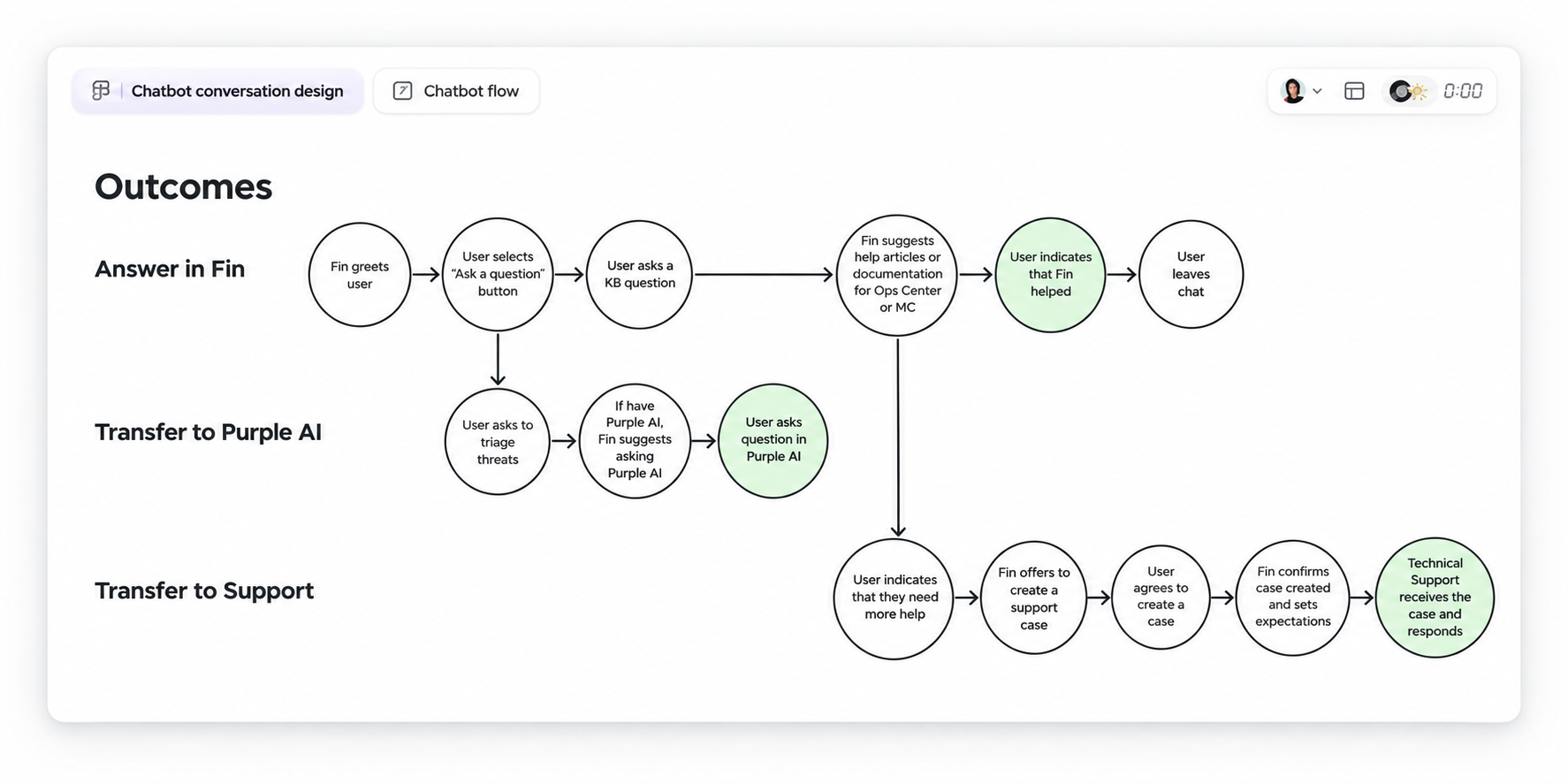
Conversation flows I designed to support self-service resolution, route users based on intent, and escalate unresolved issues to Technical Support.
Evaluating AI responses
I conducted two rounds of comparative chatbot testing in October 2025 and February 2026 using frequently searched knowledge base topics.
I evaluated responses against six criteria:
Accuracy: Technical correctness
Relevance: Alignment with user intent and product context
Completeness: Inclusion of critical details, prerequisites, and cautions
Conciseness: Length and level of detail
Actionability: Clarity of instructions and next steps
Content quality: Adherence to terminology, voice, tone, and style guidelines
I documented issues, recommended improvements, and worked with Technical Support to identify which issues we could address through content guidelines and which required changes to the underlying documentation.
Key findings
Shorter answers without sacrificing accuracy
During the second round of testing, I found that responses included more relevant prerequisites and cautions, more direct navigational guidance, and fewer unnecessary procedural details.
The chatbot delivered answers 30–50% shorter than an alternative AI support experience while retaining critical information.
Knowledge gaps that affected response accuracy
Two common support questions returned instructions for the legacy Management Console rather than Ops Center. Together, these topics accounted for 817 knowledge base searches over four months.
I identified gaps in the product documentation as the likely source of these issues. The documentation covered the legacy interface but lacked instructions for Ops Center.
Improvements in technical accuracy
I also validated improvements in the accuracy of release information, which both chatbots had answered incorrectly during initial testing.
Outcomes
SentinelOne launched its AI support experience in February 2026 following several months of beta testing and iteration.
During early deployment, the broader AI support initiative recorded:
600+ customer conversations
61% reported resolution rate for more complex troubleshooting issues
Through conversation design and evaluation, I helped the team identify opportunities to improve response quality, reduce friction in self-service support, and address knowledge gaps that affected the customer experience.